
Open up Tax Savings with Energy-Efficient Homes
Form 5695 instructions guide homeowners through claiming valuable federal tax credits for energy-efficient home improvements. Here’s what you need to know:
Quick Overview of Form 5695:
- Purpose: Claim residential energy credits that directly reduce your tax liability dollar-for-dollar.
- Two Main Credits:
- Residential Clean Energy Credit (Part I): A 30% credit for solar panels, geothermal heat pumps, and battery storage, with no annual limit.
- Energy Efficient Home Improvement Credit (Part II): A 30% credit for insulation, windows, doors, and heat pumps, with annual limits ($1,200 for most items, $2,000 for heat pumps).
- Key Benefits: Installation and labor costs are included, and credits are available through 2032 (with a phase-out starting in 2033).
- How to File: Complete Form 5695 and attach it to your Form 1040, reporting the credit on Schedule 3.
The Inflation Reduction Act of 2022 significantly expanded these credits, making energy-efficient home improvements more affordable. For homeowners planning sustainable renovations, these credits can save thousands of dollars while reducing your carbon footprint.
Important deadline: For certain products placed in service in 2025, you’ll need to include a Qualified Manufacturer Identification Number (QMID) when filing. The IRS regularly updates form 5695 instructions, so checking IRS.gov/Form5695 for the latest guidance is essential before filing.
As Pam Hutter, Principal of Hutter Architects in Chicago, Illinois, I have guided numerous clients through sustainable home design projects that maximize both environmental benefits and tax advantages using form 5695 instructions. Understanding these credits from the design phase ensures your project qualifies for maximum savings while achieving your green building goals.
Understanding the Two Major Residential Energy Credits
Residential energy credits are powerful incentives for sustainable living that reduce your tax burden. Form 5695 is the IRS document for claiming two key credits: the Residential Clean Energy Credit (Part I) and the Energy Efficient Home Improvement Credit (Part II). Unlike a deduction that lowers taxable income, a credit reduces your tax bill dollar-for-dollar. The Inflation Reduction Act of 2022 expanded these credits, creating a significant opportunity for homeowners to invest in their property’s future.
Here’s a quick comparison of the two credits:
| Feature | Residential Clean Energy Credit (Part I) | Energy Efficient Home Improvement Credit (Part II) |
|---|---|---|
| Type of Home | New and existing homes | Existing primary residences only |
| Credit Rate | 30% of costs | 30% of costs |
| Maximum Credit | No annual limit (except fuel cells) | Annual limits apply ($1,200 general, $2,000 for specific items) |
| Carryforward Rules | Yes, unused credit can be carried forward | No, excess credit is lost |
| Typical Projects | Solar panels, geothermal, battery storage | Insulation, windows, doors, heat pumps, energy audits |

Part I: The Residential Clean Energy Credit
This credit incentivizes the installation of major clean energy systems. It offers a generous 30% credit on the cost of eligible property placed in service from 2022 through 2032. The credit is available for new and existing homes, including both primary and secondary residences.
A key benefit is that there is generally no annual limit on the credit amount (with an exception for fuel cell property). This allows you to claim 30% of your total qualifying costs, no matter how large. If your credit exceeds your tax liability for the year, the unused portion can be carried forward to future tax years, ensuring you receive the full benefit of your investment.
Part II: The Energy Efficient Home Improvement Credit
Part II of Form 5695 instructions covers a broad range of smaller, impactful energy-efficient upgrades for your existing primary residence. This credit also offers a 30% rate on qualified improvements but is subject to annual limits, allowing you to plan upgrades over several years.
There is a general annual credit limit of $1,200 for improvements like insulation, doors, windows, and central air conditioners. However, specific items like heat pumps, heat pump water heaters, and biomass stoves have a separate, more generous annual limit of $2,000. This means you could potentially claim a combined total of $3,200 in one year. Unlike the Part I credit, any portion of this credit that exceeds your tax liability is lost and cannot be carried forward.
For more detailed information on specific improvements and their eligibility, we’ve put together a comprehensive guide: More on the Energy Efficient Home Improvement Credit
What Qualifies? A Detailed Look at Each Credit
To claim these credits, your improvements must meet specific IRS criteria. Attention to detail here ensures your investment translates into tax savings.
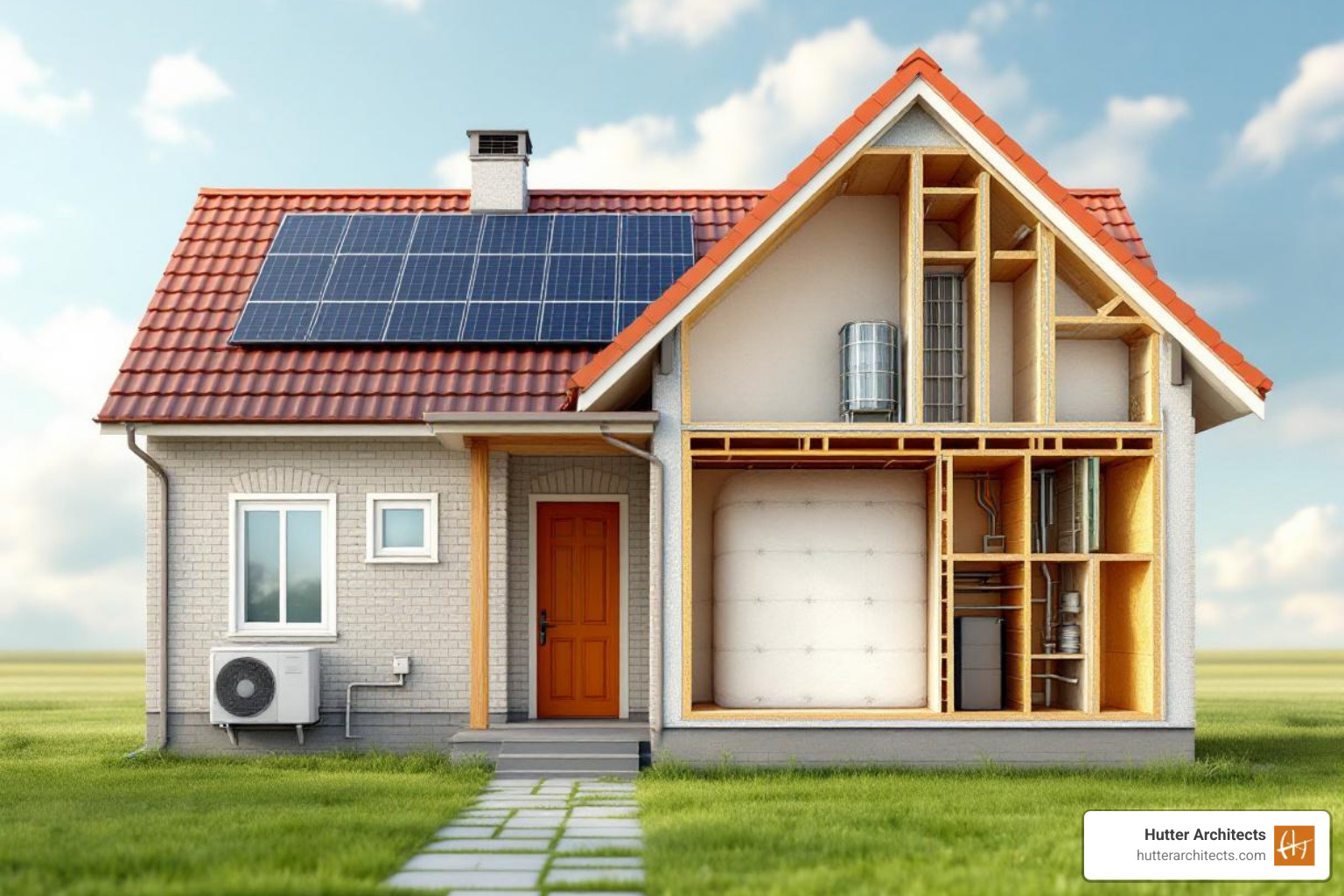
Part I: Residential Clean Energy Credit Qualified Property
The 30% credit applies to the cost of the property and labor for onsite preparation, assembly, or original installation. Here’s what typically qualifies:
- Solar Electric Property: Solar panels (photovoltaic systems) that convert sunlight into electricity, including solar roofing tiles or shingles.
- Solar Water Heaters: Systems using solar energy to heat water for your home. They must be certified by the Solar Rating and Certification Corporation (SRCC) or a comparable entity and cannot be used for pools or hot tubs.
- Battery Storage Technology: Battery storage with a capacity of at least 3 kilowatt-hours (kWh), for systems placed in service after 2022.
- Small Wind Energy Property: Small wind turbines (up to 100 kilowatts) that generate electricity for your home.
- Geothermal heat pumps: Systems that use stable underground temperatures for heating and cooling and meet ENERGY STAR® requirements.
- Fuel Cell Property: This credit is capped at $500 for each 0.5 kW of capacity. The fuel cell must have an electricity-only generation efficiency greater than 30%.
If an item has both a qualifying and non-qualifying function, only the allocable cost of the qualifying function can be claimed.
Part II: Energy Efficient Home Improvement Credit Qualified Property
This credit is 30% of the cost for improvements to your home’s building envelope and mechanical systems, up to specific annual limits.
Building Envelope Components:
- Insulation and Air sealing: Materials or systems that meet the 2009 International Energy Conservation Code (IECC) standards and reduce air leakage.
- ENERGY STAR® certified appliances: Certain appliances, like heat pump water heaters, can qualify if they meet specific ENERGY STAR® standards.
- Exterior doors: Must meet ENERGY STAR® requirements. The credit is limited to $250 per door, up to a $500 total annual limit.
- Windows and skylights: Must meet ENERGY STAR® requirements, with a combined annual credit limit of $600.
Residential Energy Property:
- Heat pumps: Electric or natural gas heat pumps and heat pump water heaters that meet specific Consortium for Energy Efficiency (CEE) standards. These have a $2,000 annual credit limit.
- Biomass stoves and boilers: Systems using biomass fuel that have a thermal efficiency of at least 75%. These also fall under the $2,000 annual limit.
- Electrical panel upgrades: Upgrades necessary for installing other qualified property, with an annual credit limit of $600.
- Home energy audits: You can claim 30% of the cost, up to $150, for an audit by a qualified professional.
Other qualifying items like central air conditioners, furnaces, and water heaters generally fall under the $1,200 annual credit limit.
For a more comprehensive look at what qualifies, check out our guide: What Qualifies for Energy Efficient Home Improvement Credit
Your Step-by-Step Guide to Form 5695 Instructions
With a little preparation, you can accurately complete Form 5695 instructions and claim the credits you deserve. Here’s a step-by-step guide.
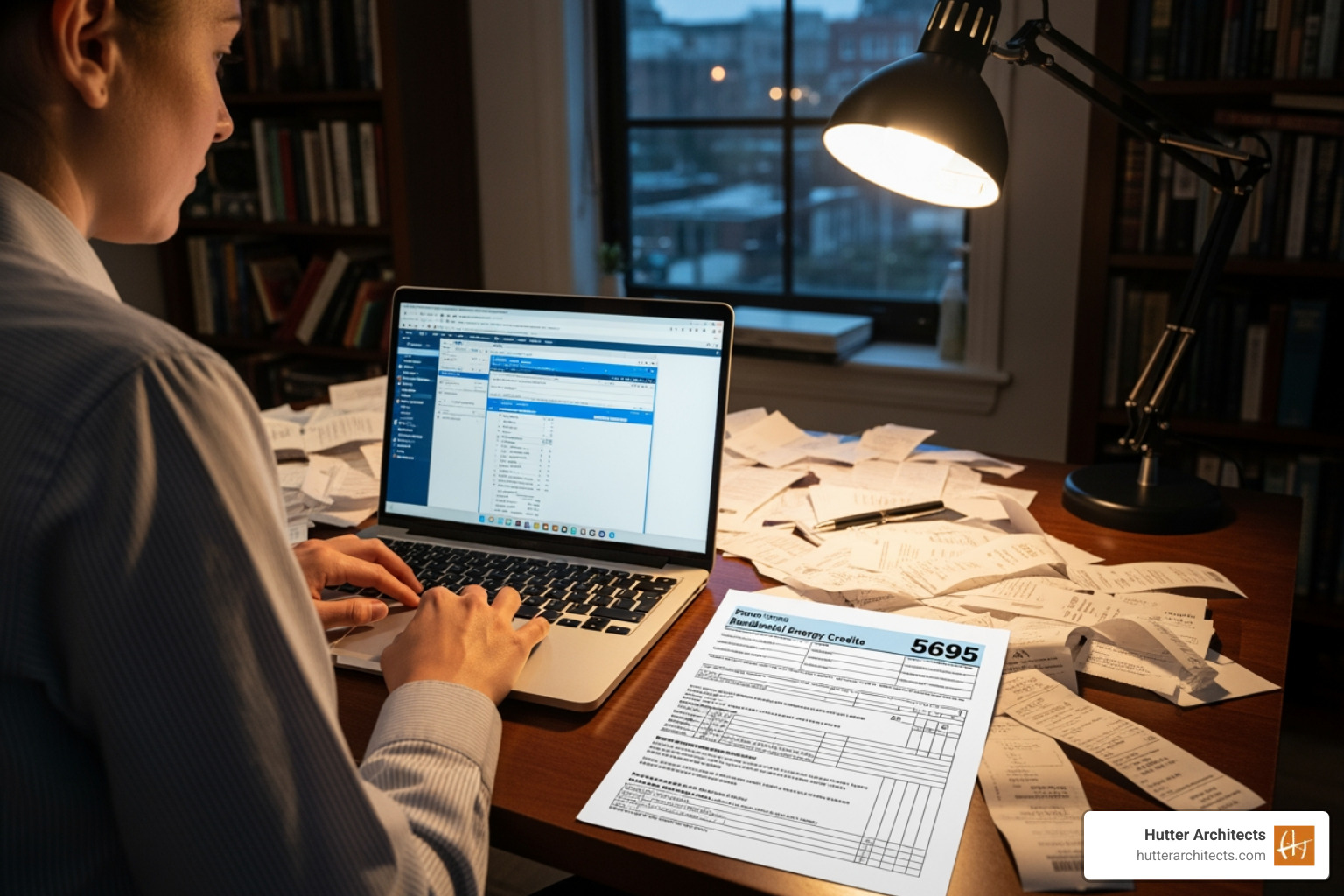
Step 1: Gather Your Documentation
Before starting the form, gather all relevant documentation to ensure accurate filing and for your records.
- Invoices and receipts: Collect all documents showing the cost of the property and any associated installation labor.
- Manufacturer’s Certification Statements: Keep the manufacturer’s statement or Qualified Manufacturer Identification Number (QMID) confirming the product meets energy efficiency standards. You don’t attach these to your return but must have them for your records. A QMID will be required for certain property placed in service starting in 2025.
- Proof of installation date: The credit is claimed for the tax year the property is “placed in service” (fully installed and ready for use).
- Subtracting incentives: You must subtract any non-taxable rebates or state credits from your costs before calculating the credit. For more on various incentives, you can check resources like Rebates, state credits, or incentives.
Step 2: A Guide to Part I Form 5695 Instructions
Part I is for the Residential Clean Energy Credit. You will list the costs for each qualifying property (solar, geothermal, etc.), including installation labor. The form guides you to calculate 30% of these costs, applying the specific limit for fuel cell property ($500 per 0.5 kW of capacity). The form 5695 instructions also explain how to apply any carryforward credit from previous years so you can use the full value of the credit over time.
Step 3: A Guide to Part II Form 5695 Instructions
Part II covers the Energy Efficient Home Improvement Credit and requires attention to specific annual dollar limits. You will enter the costs for improvements like insulation, windows, heat pumps, and home energy audits. The form then helps you apply the limits:
- A combined $1,200 limit for many improvements, with sub-limits like $600 for windows, $250 per door (up to $500 total), and $600 for electrical panels.
- A separate $2,000 annual limit for heat pumps, heat pump water heaters, and biomass stoves/boilers.
- A $150 limit for home energy audits.
There is no carryforward for unused credit from Part II.
Step 4: Calculating and Claiming Your Total Credit
Finally, you will sum your credits and apply them to your tax liability.
- Sum credits: Add the totals from Part I and Part II.
- Tax liability limitation: A worksheet ensures your credit doesn’t exceed your tax liability. The Part I credit can be carried forward, but the Part II credit cannot.
- Report on Schedule 3 (Form 1040): Transfer the final credit amount to Schedule 3 (Form 1040), Line 5, to directly reduce your tax.
- File the form: File Form 5695 with your Form 1040.
Always refer to the official IRS Form 5695 and its instructions for the most current guidance.
Special Considerations and Key Deadlines
Certain scenarios and upcoming deadlines for Form 5695 instructions require special attention to maximize your savings.
Navigating Joint Occupancy, Multiple Properties, and Basis Adjustments
Here’s how to handle common complexities:
- Joint Occupancy rules: If you co-own a home with someone other than a spouse and you both pay for improvements, you must allocate the costs and the credit based on the percentage each person paid. Each co-owner files their own Form 5695.
- Multiple properties: The Residential Clean Energy Credit (Part I) can be claimed for your main home and a second home. The Energy Efficient Home Improvement Credit (Part II) is limited to your existing main home only.
- Cost basis impact: Claiming a residential energy credit generally requires you to reduce your home’s cost basis by the credit amount. This can affect the calculation of capital gains when you sell your home.
- Founders and home offices: If an improvement benefits both business and residential parts of your home, you may need to allocate costs. If the item is used less than 80% for nonbusiness purposes, only the nonbusiness portion of the cost is eligible for the credit. Consult a tax professional and refer to Form 8829 if you claim business use of your home.
Key Deadlines and Future Changes
Be aware of these important dates and requirements:
- Credit expiration and phase-out: The Energy Efficient Home Improvement Credit ends after December 31, 2032. The Residential Clean Energy Credit’s 30% rate is available through 2032, then phases down to 26% in 2033 and 22% in 2034, ending after that year.
- Qualified Manufacturer Identification Numbers (QMID): Starting January 1, 2025, you must include a QMID from the manufacturer when claiming the Energy Efficient Home Improvement Credit for certain items like doors, windows, and other qualified property.
- Staying updated: The IRS frequently updates its guidance. Always consult the Official residential energy credit guidance on the IRS website or a tax professional for the most current information.
Frequently Asked Questions about Form 5695
Here are answers to common questions about Form 5695 instructions.
Can I claim these credits for a rental property I own?
Generally, no. These credits are for your personal residence. The Energy Efficient Home Improvement Credit (Part II) is only for your existing main home. The Residential Clean Energy Credit (Part I) can be used for a main and second home, but not for a property used solely as a rental business.
What if my credit is larger than my tax liability?
The rules differ for each credit:
- Part I (Residential Clean Energy Credit): If this credit is larger than your tax liability, you can carry the unused portion forward to reduce your taxes in future years. You don’t lose the excess amount.
- Part II (Energy Efficient Home Improvement Credit): This credit has no carryforward provision. If your credit exceeds your tax liability for the year, the excess amount is lost. This makes strategic timing of your improvements important.
Do I need to itemize my deductions to claim these credits?
No. These are tax credits, not deductions, so you can claim them whether you take the standard deduction or itemize. You complete Form 5695 and transfer the final credit amount to Schedule 3 (Form 1040) to directly reduce your tax bill.
Conclusion: Building a Greener Future with Smart Tax Planning
Utilizing Form 5695 instructions is a powerful strategy for homeowners investing in clean energy. The Residential Clean Energy Credit and the Energy Efficient Home Improvement Credit offer substantial incentives to create a more sustainable and valuable home. At Hutter Architects, we believe thoughtful design and smart financial planning are key to maximizing your returns. By understanding what qualifies, gathering documentation, and meeting deadlines, you can confidently claim these tax savings.
For those in Chicago, Illinois, planning a new net-zero home or a major sustainable renovation, working with an experienced firm like Hutter Architects ensures your project is designed to meet both your lifestyle goals and the technical requirements for these valuable tax credits. We’re here to help you build a greener future, one energy-efficient home at a time.
To learn more about designing a home that leverages these benefits, explore our guide to Energy Efficient Home Improvements Tax Credits


